
Warehouse racking reconfiguration is a process that requires planning, modifying, redesigning, or even upgrading your storage system. It’s more than just rearranging beams and frames. It’s about making your space work for you and facilitating operations.
If your warehouse feels disorganized, slow, or unsafe, it means your space is costing you money and time, as inefficient flow causes downtime and downtime results in higher costs with lesser productivity and reduced revenue. The proper pallet racking and shelving reconfiguration solves these issues while addressing safety concerns that can lead to costly liabilities.
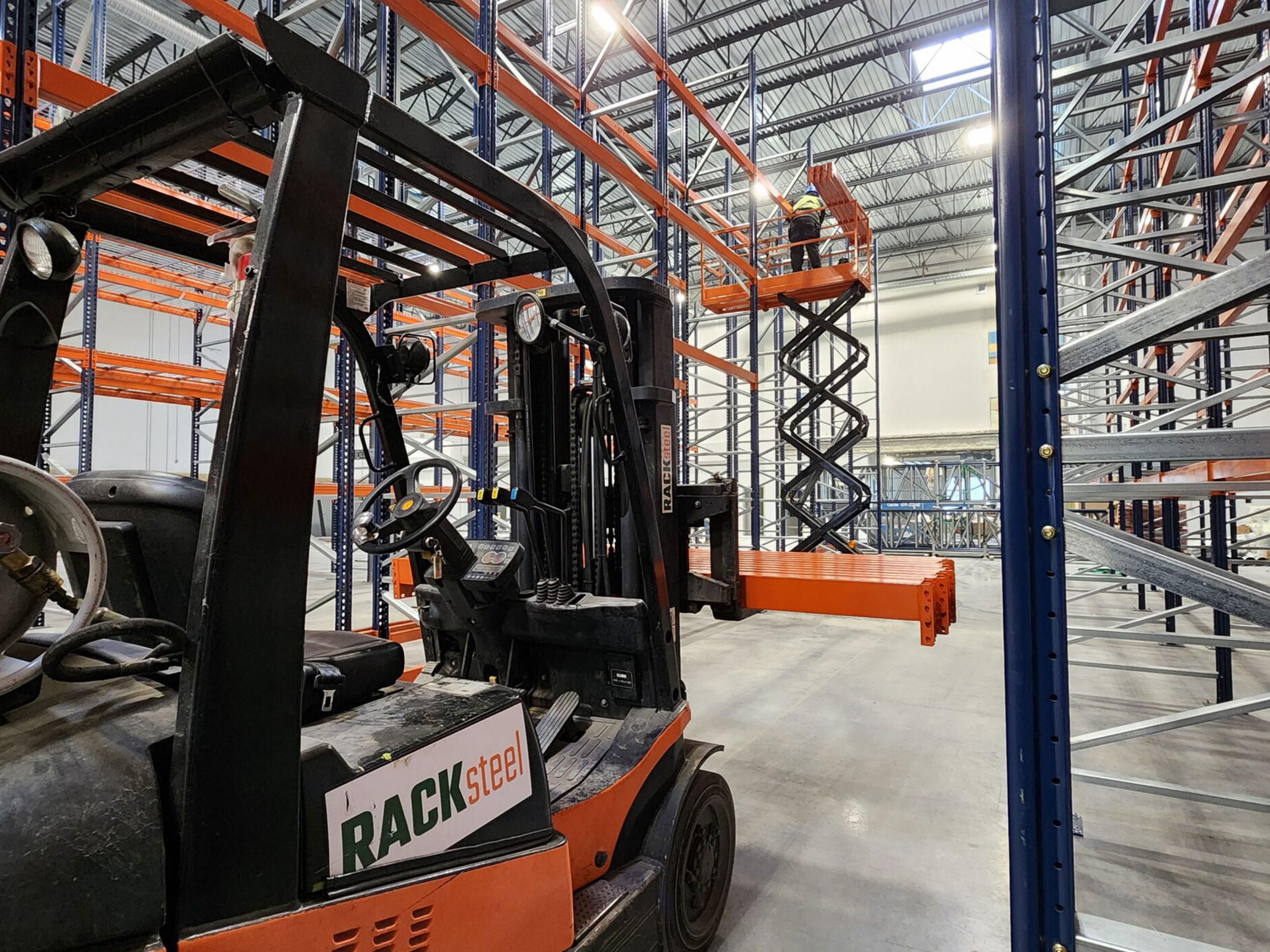
Step 1: Analyzing Current System Layout vs. Your Warehouse Needs
Begin examining your existing pallet racking system. Ask yourself:
- Is it designed for your actual inventory, or is it based on your old product sizes and volumes?
- Are your aisles too wide or too narrow?
- Are you utilizing your full vertical space?
- Are your forklifts able to move easily through tight areas?
- Has your SKU count grown?
Your storage system needs to be designed for your type of product, pallet size, and turn rate. If your business has expanded, your storage system needs to expand with it. The right pallet racking system reconfiguration starts with a clear understanding of the gap between your existing system and your actual needs.
Step 2: Planning
Now that you understand what the problems are, you can begin to plan with precision. This includes measuring everything, from ceiling height to column spacing, without skipping dock positions, fire exits, and sprinkler clearances. If you need assistance, our professional drafter can perform an in-depth site survey and create accurate, digitized versions of your warehouse space.
Next, analyze how people and equipment move to map your workflow and understand forklift traffic patterns to locate traffic bottlenecks. Each unnecessary movement cuts productivity.
Finally, look for a racking or shelving system that matches your inventory type. Consider:
- Maximum load capacity per level
- Pallet size
- Inventory turns (e.g. FIFO or LIFO)
You will also need to consider local safety regulations and seismic requirements. Safety is not optional. That’s why your racking reconfiguration must comply with building codes and load-bearing specifications. Incorrect installation often leads to costly damage, penalties, and injuries. Contact RACKsteel for more information to ensure compliance.
Step 3: Evaluating Options
Not all pallet racking and shelving systems are used for the same purpose. The best system for your warehouse will depend on your inventory and picking method.
These are the most popular types of pallet racking systems used in a warehouse:
- Selective racking, including VNA options that requires a narrow aisle reach truck which allow direct access to all pallets
- Double deep racking requires double deep forklift, which maximize storage space (but it minimizes accessibility)
- High density racking to storage large volumes of similar products, including:
- Drive-in racking (Last-In, First-Out) and drive-through pallet racking (First-In, First-Out)
- Push-back pallet racking for dynamic storage
- Pallet flow racking to enhance FIFO inventory management
- Cantilever pallet racking, ideal for storing long or irregularly shaped products
- High density shelving for maximizing storage capacity in areas with smaller, hand-loaded items
- Mobile shelving that reduces aisle space by mounting units on movable bases
- Structural racking for extremely heavy loads and demanding warehouse environments
- Storeganizer product for hand bombing areas of the warehouse, improving organization, accessibility, and efficiency
- Wide-span shelving for medium to heavy hand-loaded products that need more open shelf space
Each option affects storage density, picking speed, material handling requirements, and future scalability. When planning a pallet racking system reconfiguration, it’s essential to consider these factors.
Step 4: Choosing the Right Storage System
Now you need to make an informed decision. When selecting your system, be sure to choose one that will suit your business operations in the future, not just your today’s inventory. It’s also essential that you take into consideration your budget, your inventory needs, and your racking material lead times.
You’ll also need professional racking engineering assistance to calculate the load requirements and certification of concrete slab. Racksteel also provides a city permit submission service or permit grade racking drawings to help you get your racking approved by the city.
By working with experienced professionals, you’ll be able to design your new layout to optimize your storage efficiency. This step helps protect your investment and avoid costly rework.
Step 5: Look for a Trusted Partner for Products and Installation
The quality of the installation service is as important as the racking quality. A trusted partner who understand warehouse optimization, not just product sales, offers:
- Engineered products designed for long lifespan
- Code-compliant components
- Accurate layout drawings
- Safe installation services
- After-sale support able to provide a consultation on technical aspects of pallet racking
Poor installation causes misalignment, instability, and safety hazards. If the installer is not properly trained, the system may fail an engineering inspection, often requiring the entire racking setup to be offloaded, uninstalled, and reinstalled, causing delays and added costs.
With the right pallet racking contractor, your system relocation goes smoothly from design to final walk though. At RACKsteel, our in-house installation crew is trained to meet all safety and engineering requirements, with hands-on experience across projects of all sizes completed every day.
Step 6: Implement Improvements
This is when the plan turns into results, so schedule the racking installation, remove old racks safely, and get a professional team to do your new installation. Last but not least, educate your staff on racking safe loading practices, post new capacity labels as per the stamped engineered drawings, and make sure your staff doesn’t overload the racking.
Once installation is done, evaluate results:
- Has the speed of picking improved?
- Has storage capacity increased?
- Has damage incidence reduced?
- Has the whole warehouse process become more efficient?
Optimization is measurable and a well-executed racking reconfiguration results in better workflow, more space, more organization, and better safety standards.
Get Expert Guidance
Optimizing a warehouse is not an easy task, especially because it involves expertise in warehouse layout, safety procedures, and product selection. This is where RACKsteel comes in to make a difference.
Here’s what we help you achieve:
- Maximize storage space without having to expand or build a larger warehouse
- Improve warehouse flow and productivity
- Comply with safety and building regulations
- Choose a properly engineering pallet racking system
- Expert installation of warehouse storage systems
By seeking guidance from the racking specialists, you avoid costly mistakes and achieve a warehouse layout that performs well and maximizes space.
If you are feeling that your warehouse is too tight or inefficient, then it’s time to consider a pallet racking reconfiguration that will provide you with a warehouse that is space optimized and gives you control over operations.
To get expert guidance on warehouse optimization, call RACKsteel today.